The Splashback Afterthought: Getting the Toughest 600mm in the Kitchen Right
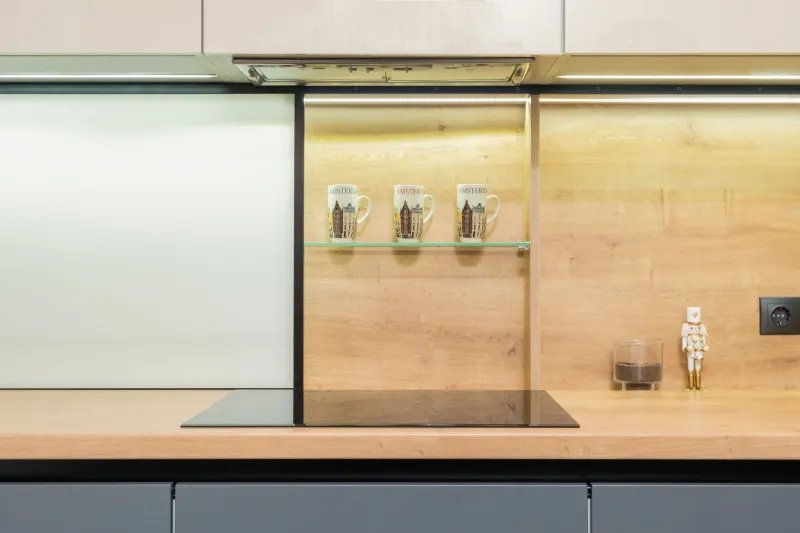
There is a line near the bottom of most kitchen quotes that reads something like 'splashback: allow £150'. It is usually wrong, and it is almost always the last thing anyone thinks about. By the time the worktop has been argued over and the cabinets have been chosen twice, the 500 to 600mm band behind the hob and sink gets whatever is left in the budget and whatever the fitter can supply at short notice.
That is a strange way to treat the hardest-working surface in the room.
The most abused strip in the house
Think about what happens in that narrow band. Boiling pans send steam up it. Frying pans throw oil at it. Tomato sauce, tea, stock and the contents of a badly timed blender all end up there. It gets wiped daily, scrubbed weekly and occasionally attacked with a scourer. Meanwhile, the worktop beneath it gets all the attention and most of the budget.
The practical question is not which splashback looks nicest in a showroom. It is which one you can live with after three years of Sunday roasts. Grout is the usual weak point: pale grout behind a hob turns the colour of old chip oil and no amount of scrubbing brings it back. Glass hides everything until it is smeared. Stone looks lovely but needs sealing and careful cleaning. None of these are deal-breakers, but they should be decisions rather than accidents.
What is actually on offer in 2026
Prices below are rough UK ranges for a 600mm-high band, supplied and fitted, per linear metre. Regional variation is real, and London will add a premium, but these are useful planning figures.
Tiles
Ceramic or porcelain tiles are still the default, and for good reason: they are cheap and forgiving. Expect £40 to £90 per square metre for the tiles and £40 to £70 per square metre for fitting, which puts a 600mm band at roughly £50 to £100 per linear metre. Trims, adhesive and a decent installer push it towards the top of that range.
The grout is where the money goes. Standard cementitious grout will discolour behind a hob; epoxy grout costs more but resists staining and grease far better. Large-format tiles mean fewer joints to clean, which matters more than any design trend. If the wall is uneven, tiling can be the most practical way to flatten it out.
Glass
A made-to-measure painted glass panel is the easiest surface to wipe in the entire kitchen. There is no grout, no texture and nowhere for grease to hide. A basic painted panel at 600mm high runs about £180 to £300 per linear metre supplied and fitted, with socket cut-outs, polished edges and coloured glass adding to that. Full-height glass, which is increasingly popular, is nearer £250 to £400 per linear metre depending on height and complexity.
Glass needs to be templated after the worktop is in, so it is a later decision than most people expect. It also has to be specified for the heat source: behind a gas hob, check the manufacturer's temperature rating and clearance requirements carefully. Induction is kinder, but the panel still needs to be toughened and properly rated.
Solid-surface upstands
A 100 to 150mm upstand in the same material as the worktop costs roughly £50 to £100 per linear metre. It looks neat and handles splashes at worktop level, but it does not protect the wall above it. Behind a hob, an upstand alone is optimistic; you will still be repainting or scrubbing the wall above.
Sloped or moulded stone
A traditional sloped stone upstand behind the hob, often 100 to 150mm high, costs about £80 to £150 per linear metre. It is easy to wipe and suits older properties, but it is a detail rather than full protection. Pair it with tiling or glass above if the hob is a busy one.
Stainless steel
Behind a range cooker, brushed stainless steel is hard to beat for sheer durability. Expect £150 to £300 per linear metre. It scratches, and it shows every fingerprint, but it laughs at heat and steam. It is also the least likely option to look tired in a decade.
Full-height stone or matching panel
A full-height panel in quartz, sintered stone or a matching worktop material costs roughly £250 to £500 per square metre, so a 600mm band works out at £150 to £300 per linear metre. It is heavy, needs support and careful jointing, and is unforgiving of uneven walls. But it is almost indestructible and looks properly considered.
Brief it with the worktop, not after it
The single biggest mistake is treating the splashback as a finishing touch. It affects the worktop template, the electrics and the extraction. Decide the two together.
Start with the worktop material and thickness, because the upstand or panel has to meet it cleanly. A 20mm worktop with a 100mm upstand is a different detail from a 40mm worktop with a full-height glass panel. The joiner templating the worktop needs to know what is going on the wall, and the splashback supplier needs the same measurements. If glass is being measured after the worktop is fitted, allow for the lead time; it is not a next-day item.
This is also the moment to settle the electrics. Sockets above a worktop need to sit at least 300mm horizontally from the edge of the hob and should not be directly above it. That is partly a safety matter and partly common sense, but it has to be agreed before the tiles are cut or the glass is ordered. Moving a socket later means cutting a hole in a finished panel.
The details people forget
Extraction clearance is the one that catches people out. Every hob and hood combination has a minimum distance between the two, and it is usually 600mm or more above the hob. Do not let a tall splashback or a decorative shelf force the extractor lower than the manufacturer allows. If you are having a full-height panel, check how it meets the chimney of the hood and whether the ducting boxing will interrupt it.
Sealing matters more than most people expect. Use a neutral-cure silicone at the joint between the worktop and the splashback, especially with stone and glass; standard acetic silicone can discolour some surfaces and attack others. Leave a small movement gap rather than cramming the panel tight, and do not grout that joint. It will crack.
Then think about the edges. How does the panel finish at a window, a cabinet or a corner? End trims and polished edges cost extra but make the difference between a fitted splashback and a piece of material screwed to the wall.
Is a full-height panel worth it?
Sometimes. If the wall is uneven, glass is a brilliant way to hide it. If you hate cleaning grout, it is the obvious choice. If the budget is tight, a full-height panel behind the hob with painted wall elsewhere can work, but remember that grease travels further than you think.
The sensible middle ground for many kitchens is a 600mm-high glass or stone panel behind the hob, a matching upstand around the rest of the worktop, and a scrubbable paint above. It is not the cheapest option, but it is honest about where the punishment actually lands.
The bottom line
A splashback is not trim. It is a working surface, and it deserves a proper brief. Choose it with the worktop, agree the socket positions and extraction clearance early, seal the joints properly, and spend where you will actually touch. The 600mm behind the hob will take more abuse than the rest of the kitchen put together, so it is worth getting right the first time.