What Your Shelves Aren't Telling You: An Honest Look at Open Storage
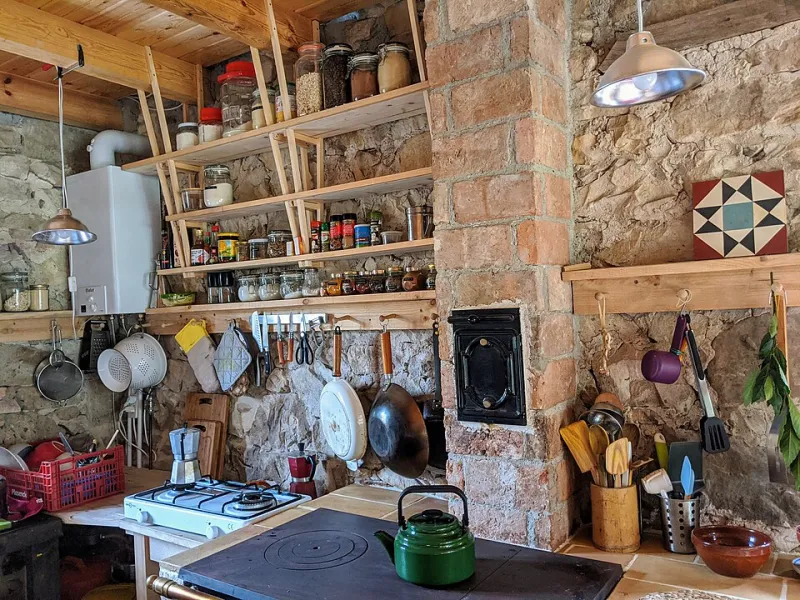
Photo: Neil Cummings, CC BY-SA 2.0, via Wikimedia Commons
There is a particular kind of kitchen photograph doing the rounds on every property site and interior feed you've ever scrolled. Pale wall, three floating shelves, a stack of artfully mismatched bowls, one ceramic jug, a sprig of something. It is beautiful. It is also, in most real homes, about four days away from being covered in a fine film of cooking grease and a chaos of unpaid bills.
None of which means open shelving is a bad idea. It means we should stop pretending it's a styling decision and start treating it as a storage decision, with all the boring practicalities that implies. If you're planning a kitchen in 2026 and wondering whether to leave a wall open or fill it with cupboards, here's the honest version.
Why open shelves keep winning the argument
Start with the practical case, because it's stronger than the aesthetics crowd usually admits. In a small kitchen, a run of open shelves can do something a cupboard can't: it stops the wall from feeling like a solid block of joinery. A room three metres by two and a half can absorb a lot of cabinetry if there are moments of lightness and space between it. Open shelving is one of the cheapest ways to break up that mass.
Then there's access. A shelf at eye level requires one movement. A cupboard requires a handle, a hinge and a decision about where to put the thing you're holding while you open it. If you cook every night and your plates, mugs and pans live on open shelves within arm's reach of the hob, you'll notice the difference in a way you simply won't with a decorative display.
And yes, it costs less. A modest run of solid-timber or good-quality floating shelves will typically set you back a fraction of the equivalent wall of fitted cupboards, and the money saved is often better spent on a decent extractor or a worktop you'll actually enjoy. If your budget is already feeling tight after reading our earlier look at what a mid-range kitchen really costs, this is a genuine lever.
The zones where shelves fall apart
Here's where the photographs and the reality part company. Open storage fails in specific, predictable places, and none of them are about taste.
Within about a metre of the hob. Anything exposed to cooking will collect airborne grease. Shelves directly above or beside a hob are a magnet for it, and the grease doesn't just sit on the shelf; it coats every surface of every object, including the inside rims of things you'd rather not scrub with a cloth every fortnight.
Near the kettle and toaster. Steam is relentless. A shelf above the kettle is effectively a condensation trap, and whatever sits on it will feel faintly damp every morning. If you drink four cups of tea a day, multiply that by years.
On a wall shared with a doorway or a busy route. This is the dust shelf, the one nobody warns you about. Kitchens generate dust in a way that surprises people: flour, crumbs, pet hair migrating in from the hall, the general settling that happens in any room with a door to the outside. The top of a tall cupboard hides it. A shelf displays it.
Anywhere above head height. A shelf at two metres is decorative storage, in the sense that you'll decorate it once and then store things there you never use. Fine if that's the plan. Less fine if you genuinely need the space.
Where shelves genuinely earn their keep
Given all that, the shelf that works is usually the one that sits in the calmest part of the room, holding things you use constantly, and doing double duty as the place where the kitchen's character lives.
The most reliable spot is the wall opposite the cooking zone, or the end of a run that doesn't face the hob. It's out of the steam and spatter, it's visible when you walk in, and it's where the everyday crockery looks genuinely good because it's meant to be there rather than arranged.
A second reliable spot is a short run beside the sink, above the draining board, where mugs and glasses can air and dry within reach. Shelves here need to be a sensible depth, around 25 to 30 centimetres, and positioned so the bottom shelf clears the tap and the tallest thing you'll put on it. A common mistake is to measure the shelf but not the kettle.
Deeper shelves, 30 to 35 centimetres, become genuinely useful storage for plates, bowls and small pans. Shallower shelves, around 20 centimetres, are best kept for mugs, jars, spices and the small things that clutter a worktop. Mixing depths along a wall looks intentional and, more usefully, stops the shelf from becoming a display shelf by default.
The hybrid wall: how to plan it properly
The kitchen that survives real life usually mixes open and closed storage on the same wall, so you get the lightness without the maintenance nightmare. Some practical rules that hold up:
- Put the closed cupboards at the ends of the run and around any tall appliance. This anchors the wall and stops the open section looking like a gap.
- Keep the open section to a maximum of about 1.2 to 1.5 metres of shelf width. Beyond that, it starts to look like a shop display and starts to demand more tidying than anyone has time for.
- Run shelves from worktop to eye level and reserve the highest shelf for something you genuinely reach for, or leave the top open as breathing space.
- Use a single material and a consistent shelf thickness. Variation here reads as clutter, even when it's clean.
- Add a strip of low-level lighting beneath the shelves if you can. It transforms how the wall looks in the evening, and in a British kitchen in November that matters more than most design decisions.
If you want the look of open shelving but not the cleaning, glass-fronted cupboards are the honest compromise. You get the display, the doors keep the grease off, and you don't have to restyle the shelves every time someone comes round.
The question to ask before you commit
Before you sign off the drawings, do one thing: stand where you'll actually stand when you cook, and look at the wall you're about to leave open. Ask yourself what will be on those shelves on a wet Tuesday in February, when the shopping hasn't been put away and there's a pan on the go. If the answer is 'the things we use every day, and it'll be fine', build the shelves. If the answer is 'I'll sort it out before guests arrive', that's not storage. That's a display, and it should be planned and budgeted as one.
Open shelving isn't a trend to be resisted or embraced. It's a tool, and like every tool in a kitchen it works brilliantly in the right place and badly in the wrong one. The trick is deciding honestly which wall you've got.