The Corner You'll Never Use: A Straight-Talking Guide to Kitchen Corner Cabinets
There's a moment in every kitchen renovation when you look at the plan, point at the corner, and say something hopeful like 'that'll be great for the big pans.' Six months later it's holding a rice cooker you've used twice and a bag of carrots that have quietly become soup.
The corner is the awkward handshake at the end of two cabinet runs. It looks generous on paper — a full 900 or 1000mm square of storage — but a good chunk of it sits behind a door hinge, beneath a worktop joint, and at the far end of your arm's reach. Getting it right is less about fancy hardware and more about being honest about how you actually live.
First, the uncomfortable maths
Take a standard 1000mm corner base unit. Subtract the carcass walls, the door, the space the hinge needs and the portion you can only reach by lying on the floor with a torch. What's left is a useful volume that is, in most British kitchens, roughly half of what the plan implies.
A carousel claws back a fair bit of that. A Le Mans pull-out does better. Corner drawers do better still. But here's the comparison nobody makes: three deep drawers in a 600mm unit will often hold more genuinely reachable stuff than an entire corner cabinet. That's the benchmark. If the corner can't beat a drawer stack, it's decoration.
The four options, ranked by how much you'll enjoy them
1. Leave it blind (the free option)
A blind corner is just a carcass with a door on one side and a void behind a fixed panel. It costs nothing extra — the unit itself is typically £100–£200 — and it's fine, provided you treat it as a cupboard for things you need twice a year. Christmas platters, the slow cooker, the spare squash. What it is not is everyday storage. If you're planning to keep the good pans in there, you'll be on your knees by February.
2. A carousel, or lazy Susan
Half-moon or full-circle trays that rotate on a central post. Aftermarket kits start around £60 and can be dropped into an existing unit; factory-fitted versions usually add £150–£300 to the cabinetry. They work best in a 900–1000mm square corner and they're genuinely useful for tins, jars and spices.
The catch is the door swing. You need a clear 90 degrees, and you need to check that tall items on the lower tray don't foul the shelf above when you spin it. Also check the tray diameter against your carcass — a full circle in a tight corner is a knuckle-scraper.
3. A Le Mans pull-out
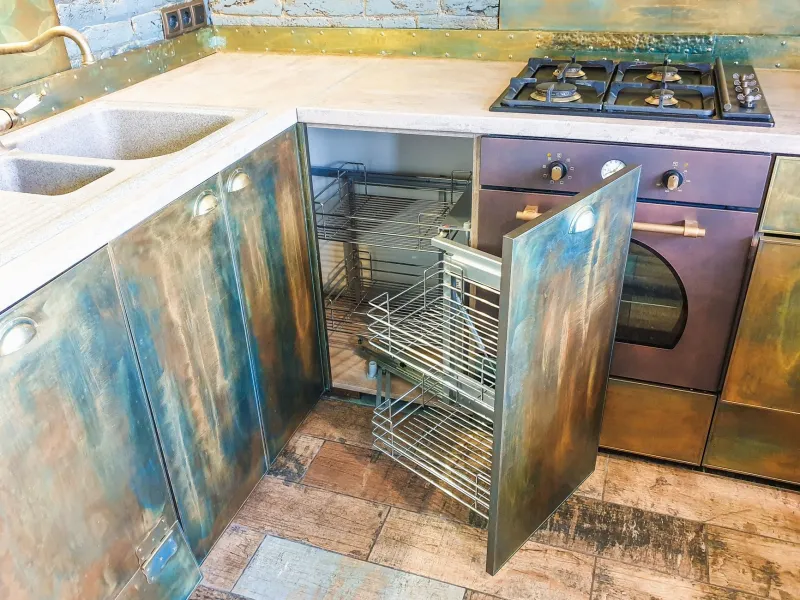
Two kidney-shaped trays that swing out of the corner as you open the door. This is the sweet spot for most people: you can see everything, reach everything, and it handles pans and large pots without complaint. Budget £250–£600 depending on brand and whether it's supplied with the unit.
One thing to check before you commit: the cabinet door usually attaches to the mechanism rather than the carcass, so the hinge adjustment matters. Ask your fitter whether they've fitted that specific make before, and make sure the pull-out clears the handles on the adjacent run when it's fully extended.
4. Corner drawers and Magic Corners
Corner drawers pull straight out from an angled or L-shaped front — no bending, no spinning, and they look smart. Expect a £300–£700 premium over a standard corner unit. Magic Corner-style mechanisms, where trays glide out and then slide sideways, are the most impressive of the lot at £500–£900.
They're lovely. They're also mechanisms, which means crumbs, grease and a legitimate question about spare parts in ten years' time. If you go this route, ask for the model number in writing and check the manufacturer's spares policy.
Angled or square? The layout question nobody asks
A diagonal corner unit — the kind with a 500–600mm door set at 45 degrees — is the underrated option. You lose a bit of worktop, but you gain a door that faces the room and a cabinet you can actually get into. In a small kitchen, that trade is often worth making.
A square corner keeps your worktop continuous and looks cleaner in a modern run, but you're back to reaching round a hinge. If worktop is precious, stay square and fit a carousel. If access is the problem, angle it.
There's a third path: put the sink or hob in the corner and use a corner base only for shallow storage. It sounds obvious, but a surprising number of plans put the most-used appliance right where the cabinet is least usable.
When to walk away from the corner entirely
Sometimes the best corner cabinet is no corner cabinet. If your room is roughly 3.6m by 2.4m and you're squeezing in an L-shape for the sake of it, price up a straight run of drawers plus a tall larder unit instead. Corner cabinetry typically costs 15–25% more than the equivalent straight run and holds less accessible volume. A peninsula or a slim pull-out pantry can absorb the storage you thought you were gaining.
This is especially worth testing in galley kitchens, where an L is often added out of habit rather than need. Draw it both ways. The straight version frequently wins on both cost and daily usability.
The questions to ask before you sign the plan
- How much of this corner is actually reachable once the door and hinge are accounted for?
- Can I open the corner and the adjacent appliance door at the same time?
- What's the make and model of the mechanism, and are spares available in ten years?
- Does the corner unit force a compromise on the drawer run next to it?
- Will the worktop need a joint over the corner, and what does that add?
- What's the fitted cost, not just the cabinet cost?
- What's the lead time if the mechanism is out of stock?
The budget lines nobody flags
Two things quietly inflate corner costs. First, fitting: mechanisms take longer than a plain carcass, and some fitters charge accordingly — budget an extra hour or two. Second, worktops. A corner almost always means a joint, and in quartz or sintered stone that can add £150–£300 depending on the fabricator.
A carousel is the sensible middle ground for most British kitchens: modest cost, real gains, and nothing to break. A Le Mans is worth the upgrade if you cook properly and hate crouching. Corner drawers are the treat. And a blind corner is perfectly fine — as long as you're honest that it's a cupboard for the once-a-year stuff, not the day-to-day.
Get the corner right and the rest of the kitchen feels calmer. Get it wrong and you'll spend a decade moving the same bag of carrots from tray to tray.