The Wall That Won’t Budge: Making a Fixed Window Work Harder in Your Kitchen
Every kitchen has one wall that refuses to join the conversation. You can move a cupboard, reroute a pipe, even knock through a wall if the budget and the building regs allow it. But the window tends to stay exactly where the builder put it. And yet, in far too many plans, it is treated as a decorative afterthought: a lovely bit of light with a sink dumped underneath it and a pair of curtains added at the end.
That is the wrong way round. In a British kitchen, the window wall is often the hardest-working wall in the room. It has to cope with light, ventilation, condensation, splashes, storage, seating and whatever the weather is doing outside. If you brief it properly at the start, the rest of the layout gets easier. If you ignore it, you end up with a beautiful room that is slightly annoying to use every single day.
Start with a window survey, not a mood board
Before you fall in love with a cabinetry colour, spend half an hour measuring the window wall properly. Note the sill height, the depth of the reveal, whether the window opens inwards or outwards, and how much wall you have on either side. Check where the radiator sits and whether it is staying. Look at the condition of the plaster around the frame and the route of any existing pipes or cables.
This sounds dull, but it saves arguments later. A deep sill can become a useful shelf for herbs and washing-up liquid. A shallow reveal might mean a tap has to be chosen carefully so it does not clash with the window handle. An inward-opening casement can rule out a tall mixer tap directly in front of it. These are not glamorous details, but they are the difference between a kitchen that works and one that merely photographs well.
The sink-under-window question
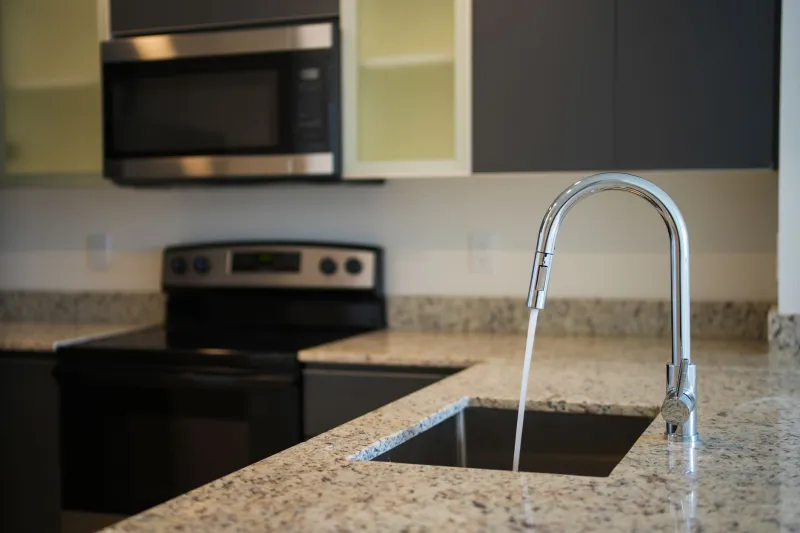
Putting the sink under the window is a classic British move, and for good reason. It gives you daylight while you wash up, a view while you fill the kettle, and a natural place for the tap. But it is not automatically the right answer.
If the window is low, the tap may obscure the view or prevent the window from opening fully. If the sill is shallow, splashes will find the paintwork. If the window is single-glazed or draughty, condensation will gather around the frame every time you boil a pan of pasta. And if you have a radiator directly beneath the window, you need to think about whether it is staying there or moving, because a sink unit and pipework will not thank you for squeezing around it.
A good compromise is to keep the sink on the window wall but shift it slightly off-centre, giving you room for a draining board or a bit of worktop. Alternatively, use the window wall for a lower run of cabinets and move the sink to a side wall, especially if that gives you a better working triangle between hob, fridge and sink. There is no rule that says the sink must face the garden. It just has to suit the way you actually use the room.
Radiators, condensation and the British weather
Radiators under windows are common in UK homes because they help counter the cold draught that falls from the glass. But in a kitchen, that wall is already busy. If you are keeping the radiator, make sure it is not boxed in by base units or blocked by a bench. If you are moving it, consider a vertical radiator on a nearby wall or underfloor heating if the budget stretches. Do not simply delete it and hope for the best in January.
Condensation is the other quiet problem. Kitchens produce a lot of moisture, and window walls are where it shows up first. Make sure your extractor is up to the job and that the window can be opened when needed. If you are replacing the window, think about trickle vents and glazing spec. If you are keeping it, check the seals and consider whether a shallow sill or tiled upstand will make wiping down easier. A window wall that is easy to clean is a window wall you will actually clean.
Blind corners and awkward geometry
Windows often leave you with a narrow strip of wall at one end, or a corner that is technically usable but practically grim. This is where blind corners appear: the cupboard that opens into nothing, the worktop that disappears into a dark recess, the space where a bin theoretically lives but no one can reach.
Plan those corners deliberately. A pull-out corner unit can make a low-level cupboard genuinely useful. A carousel is not glamorous, but it works. If the window sits close to a return wall, consider leaving that corner as open shelving or a narrow pull-out larder rather than forcing a standard cabinet into it. And if the geometry is truly awkward, use it for something that does not need daily access: a broom cupboard, a recycling pull-out, or a slim cupboard for trays and tins.
Seating that does not fight the window
A window wall can be a lovely place to sit, but only if you plan the height and clearance. A bench under a low sill can work beautifully in a bay or a wide opening, provided you leave enough depth for knees and enough clearance for the window to open. A window seat with storage underneath is a British kitchen classic for good reason, but it needs to be built at the right height for the people who will actually use it.
If the sill is high, do not force a bench underneath it. A pair of stools at a shallow peninsula might be a better fit. If you want a small table, check that chair backs do not clash with the window handle or the radiator. And if you are planning a banquette, make sure the table can be pulled out for cleaning. Window seating is brilliant when it is properly measured, and deeply irritating when it is not.
Curtains, blinds and the end of the afterthought
Window coverings are usually chosen last, which is exactly why they cause problems. Long curtains can trail into a sink, sit too close to a hob, or soak up steam. Roman blinds can look lovely but need clearance from taps and worktops. Venetian blinds are practical but a pain to clean in a kitchen. Shutters are a strong choice for window walls because they are wipeable and do not flap about, but they need to be measured around the reveal and the handles.
Think about how the window will be used. If you open it every morning, do not specify a blind that makes that a two-minute faff. If the window faces the street, consider a top-down blind that gives you light without exposing the whole room at night. If the window is in a splash zone, choose something wipeable and avoid fabric that pools. The window covering should be part of the kitchen brief, not a panic purchase the week before the fitter arrives.
The window wall deserves a proper brief
A kitchen window is not just a place to put the sink and a nice view. It is a wall that has to balance light, ventilation, moisture, storage, seating and the practicalities of British weather. Get it right and the whole room feels calmer. Get it wrong and you will spend the next ten years reaching around a tap, wiping condensation off the sill and wondering why the corner cupboard is full of things you cannot reach.
So before you finalise the layout, stand in front of that window with a tape measure and a notebook. Treat it as the hardest-working wall in the room. It may not be the most glamorous part of the project, but it is the one you will notice every single day.