The Big Fridge Audition: Will an American Fridge Freezer Actually Fit Your British Kitchen?
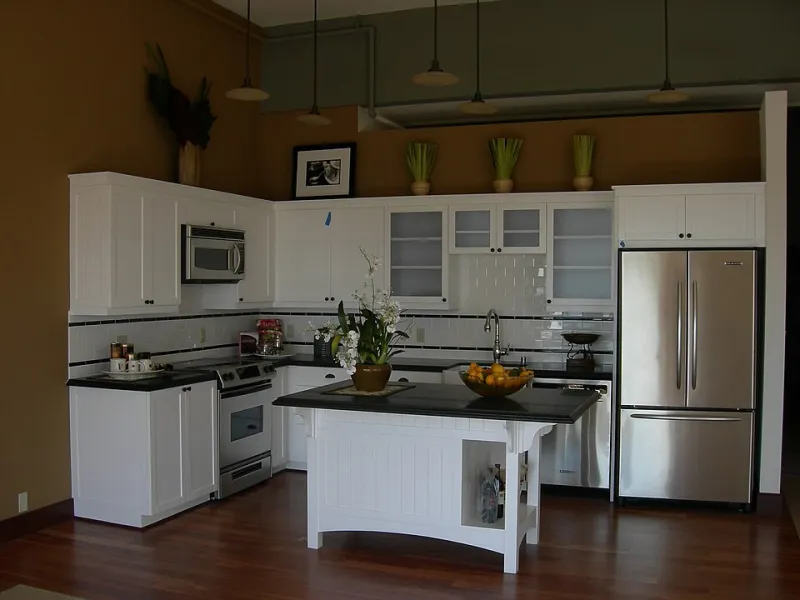
Photo: Joe Mabel, CC BY-SA 3.0, via Wikimedia Commons
American fridge freezers are the kitchen equivalent of a Labrador puppy: lovely in the showroom, considerably larger once you get them home. They promise icy water, cavernous drawers and a certain transatlantic swagger. What they do not promise is that they will fit through your door, sit flush with your cabinets or leave you enough room to open the oven. If you are dreaming of one for a 2026 renovation, treat it like an audition rather than an impulse buy. The kitchen has to say yes first.
Start at the doorway, not the showroom
The first measurement most people take is the width of the gap where the fridge will live. That is sensible, but it is not the first measurement that matters. The first is your external door and any internal doorway on the delivery route. A typical British front door opening is around 76cm, and many internal doors are similar once the frame is accounted for. An American fridge freezer is often about 90cm wide, and the packaging adds more. If the appliance cannot get in, the best layout in the world is academic.
Walk the route with a tape measure. Include the porch, the hallway turn, the step into the kitchen and any tight corner where a delivery team will need to tilt and pivot. If a doorway is marginal, ask the retailer about removing doors and packaging before delivery day. Some companies will not attempt a tight access route, and returning a fridge that never entered the building is an expensive way to learn about logistics.
Depth is the sneaky one
Width gets the attention, but depth causes the quiet regrets. Standard British base units are roughly 60cm deep, with worktops adding a couple of centimetres. Many American fridge freezers are 70cm to 75cm deep before you allow for doors, handles and the air gap behind. Push one into a run of standard cabinets and it can stand proud like a wardrobe in a terrace. That is not automatically wrong, but it changes the room. A deep appliance can narrow a walkway, block a cupboard door or make the opposite run feel cramped.
Measure from the wall to the front edge of the neighbouring cabinets, not just the carcass. Then add the fridge door thickness and handle projection. If the fridge sits in a tall housing, check the internal depth of that housing too. Some housings are designed for integrated appliances and will not swallow a freestanding American model without alteration.
Height, levelling and the ceiling
Height is usually less dramatic, but it still catches people out. Many American fridge freezers sit around 175cm to 180cm tall. Add a few millimetres for the hinge covers and a little breathing room above, and you may be closer to the ceiling than expected. In a loft conversion or a room with a sloping ceiling, check the highest point of the fridge and the lowest point of the ceiling along the whole footprint.
Levelling matters more than it sounds. Fridges need to sit level for doors to close properly and for the water dispenser to behave. British floors are not always flat, especially in older houses. Allow for adjustable feet and a small gap at the top. Do not build a tight cupboard around the fridge that assumes the floor is perfect. It rarely is.
Door swing and the walkway
A fridge door that opens into a walkway is a daily irritation. Side-by-side models often need more clearance than people expect because both doors swing outward. French-door models can be more forgiving, but the drawers still need to pull clear. Measure the space in front of the fridge and check it against the door swing in the manufacturer's instructions. Then imagine it with a hot tray in your hands and a child behind you.
Also check what is opposite. A fridge door that clashes with a dishwasher door, a cupboard run or a breakfast bar will annoy you every morning. If the fridge sits at the end of a run, make sure the last cabinet door can still open fully. Sometimes moving the fridge 10cm along the wall is enough to solve a problem that looks unsolvable on a plan.
Water lines, sockets and the plumbed question
Plumbed American fridge freezers need a water supply and a drain for the dispenser. The water line should come from a suitable supply, usually with an isolation valve, and it needs to reach the fridge without running across a walkway or behind a hot appliance. Plan the route before the first fix. If the kitchen is already finished, retrofitting a water line can mean lifting flooring or chasing a wall.
Think about the socket too. It should not sit directly behind the fridge, where it is unreachable once the appliance is pushed home. A switched socket in an adjacent cabinet or just above the worktop is often more practical. Check the manufacturer's requirements for fuse rating and clearance. And if you are choosing a plumbed model mainly for the water dispenser, be honest about whether you will use it enough to justify the plumbing. A jug in the door is cheaper and simpler.
Cabinetry, ventilation and servicing
An American fridge freezer is not a piece of furniture you can bury in a tight box. It needs ventilation, and it needs to be serviceable. Many models require gaps at the sides, top and back. Building cabinets tight to the appliance may look neat for a week and cause problems for years. If you want a fitted look, ask the cabinet designer to work from the appliance's installation guide, not from a rough guess.
Servicing is the other practical point. If the fridge fails, an engineer needs to pull it out or access the back. A surround that traps the appliance against a wall or a fixed plinth can turn a small repair into a removal job. Leave a route for the appliance to come forward, and keep the water isolation valve accessible.
A simple measuring checklist
- Measure the delivery route: external door, hallway, internal doors and any tight turns.
- Measure the fridge opening in three places: width at the top, middle and bottom.
- Measure the depth from the back wall to the front of neighbouring cabinets, then add door and handle projection.
- Measure the height from the floor to the ceiling, including skirting and any sloping section.
- Check the door swing against walkways, opposite cabinets and appliance doors.
- Confirm the water supply route, isolation valve position and socket location.
- Read the installation guide for side, top and back clearances.
- Check the floor level and allow for adjustable feet.
Budget warnings before you go bigger
The fridge itself is rarely the only cost. Going American can mean altering a tall cabinet, cutting back a worktop, moving a socket, adding a water line or widening a doorway. If the appliance sits proud of the run, you may decide to rework the whole wall of cabinets. None of that is fatal, but it should be in the quote before you fall in love.
Delivery is another line item. Some retailers charge extra for connection, old appliance removal or difficult access. Ask what happens if the fridge does not fit through the door. And do not forget the small stuff: a suitable water filter, a new isolation valve, maybe a floor protector. These are not glamorous purchases, but they are part of the real cost of the big fridge.
An American fridge freezer can be a brilliant addition to a British kitchen. It can also be the appliance that makes a narrow galley feel narrower and a careful budget feel optimistic. Measure the route, measure the gap, measure the swing and read the installation guide. Then decide whether the room is really ready for the big entrance.